Daily Om Thursday


Embed from Getty Images

Listening With Your Heart:
Less Thinking And More Feeling

Most of us were born and raised in cultures that value the head over the heart and, as a result, we place our own hearts below our heads in a sort of inner hierarchy of which we may not be conscious. What this means is that we tend to listen and respond from the neck up, often leaving the rest of our bodies with little or no say in most matters. This is a physical habit, which sometimes feels as ingrained as the way we breathe or walk. However, with effort and awareness, we can shift the energy into our hearts, listening and responding from this much deeper, more resonant place.

The brain has a masterful way of imposing structure and order on the world, creating divisions and categories, devising plans and strategies. In many ways, we have our brains to thank for our survival on this planet. However, as is so clear at this time, we also need the wisdom of our hearts if we wish to continue surviving in a viable way. When we listen from our heart, the logical grid of the brain tends to soften and melt, which enables us to perceive the interconnectedness beneath the divisions and categories we use to organize the world. We begin to understand that just as the heart underlies the brain, this interconnectedness underlies everything.

Many agree that this is the most important work we can do at this time in history, and there are many practices at our disposal. For a simple start, try sitting with a friend and asking him to tell you about his life at this moment. For 10 minutes or more, try to listen without responding verbally, offering suggestions, or brainstorming solutions. Instead, breathe into your heart and your belly, listening and feeling instead of thinking. When you do this, you may find that it’s much more difficult to offer advice and much easier to identify with the feelings your friend is sharing. You may also find that your friend opens up more, goes deeper, and feels he has really been heard. If you also feel great warmth and compassion, almost as if you are seeing your friend for the first time, then you will know that you have begun to tap the power of listening with your heart.

~ Madyson Taylor, Daily Om

divider4

“Listening is not a passive activity. It’s not about being quiet or even hearing the words. It is an action, and it takes energy to listen.” ~ Kay Lindahl

Listening. It seems deceptively easy, but think about it, how often do you really listen? For most of us, it is not very often. It is not as though we consciously set out with the goal of not paying attention to what others say, it is simply habitual. Think about it. You are involved in a conversation with someone. The other party is talking. In most cases, from outward appearances, you are listening, but inwardly, your attention is on other matters. For example, you are compiling your grocery list, thinking about getting your tax documents over to the accountant, or wondering what time your spouse said that your daughter’s soccer game was taking place. All the while, you are nodding your head as if agreeing to something said, or every now and again you add an um-hum or uh-hah. At least, it appeared that this person was listening.

On the other hand, how often have you seen conversations between two people? One person is talking, while the other is visibly uninterested in the conversation. He (Please note that I only use “he” for simplicity’s sake.) sits, slouched in his chair, arms across his chest, and avoiding eye contact with the person speaking. Then, there are those who are looking everywhere but at the person who is talking. Another tactic is to seem to listen, but to continually interrupt the other person, form a response to something said minutes ago, or raise his voice speaking over the other person. None of these people are practicing the art of listening.

As the quote notes, listening is an active activity. How we listen may harken back to childhood. Undoubtedly, raising a family requires enormous amounts of time and effort. I know that first hand. Nonetheless, as a child, I can’t remember a time when my harried mother had the time to sit down, look me in the eye, and fully listen to my questions or what I had to say. Our conversations typically took place while she was preparing dinner, washing clothes or one of the other myriad tasks that it takes to care for a household. I don’t fault my mother, (In all honesty, I can’t say that I behaved differently with my children.) because as a single mom, she did the best that she could. I only bring this up to illustrate that the way we listen can result from learned behavior.

True listening is a gift that we give to another person. It may be difficult, but we owe it to them and to ourselves to listen with our whole heart. In the midst of our busy lives, it takes time and effort to sit with someone and really hear what they are saying. The exchange is a practice in mindfulness and it serves as a benefit to both you and the other person. By deeply listening, you can offer an informed response based on the totality of their words. Given that they act similarly, both of you part with a sense of communion brought by the powerful spirit of mutual listening.

postsiggie2

Daily Om Thursday


Embed from Getty Images

People in Need:
Taking Our Turn to Give

When we see a person in need, we may want to give them something as a way of helping them, but if we give without taking the time to see who they really are, honoring that most of all, our gift is nowhere near as powerful as it could be. We may want to give a homeless person a sandwich, for example, but if we give it without also taking a moment to look the person in the eye, making authentic contact, we rob them of the experience of being human.

Being in a position of need leaves a lot of people feeling vulnerable and full of self-doubt. The greatest gift we can give is to meet people in need without judgment and with the awareness that we are not superior to them simply because we are not currently in their position. If we take the long view, we can see that we all began life in need of a lot of care and attention, and many of us end life in the same way. Giving and receiving are companion energies that take turns throughout our lives, and we all get a chance to be on both sides of the exchange from time to time.

It’s important to be aware of our own tendency to give from a desire to feel good about ourselves, rather than from an acknowledgement of our connection to all people. Letting go of our self-importance allows us to see that, regardless of appearances, we are all givers and receivers. When we are in the position of the giver, we honor those we are helping when we remember the many people who have helped us. Then we can look the person we are helping in the eye, aware that we are making contact with a human being who is our equal. ~ Madyson Taylor, Daily Om

divider4

In these times, it is rare that we don’t pass a person on the road, holding a sign requesting help. My initial reaction is one of sadness, and invariably, I fish around my purse to extract a dollar or two. When I hand it to them, I force myself to look them in the face and say “God bless you.” Afterwards, I drive away hoping that I’ve done some good and not contributed to a drug or alcohol addiction. Yet, who am I to assume the worse about this person. Without thinking about it or even intending to, I’ve done much worse — passed judgment on this person without knowing his or her story and what brought them to that place.

As I wrote the above paragraph, I realized that beyond the judging, I did something else for which I’m not proud. Why do I have to “force” myself to look into the person’s face and not their eyes? (As an initial matter, I have to say that I, too, believe that we are each connected.) Anyway, after giving it some thought, I realize that fear is at the root of the question. It is the fear wrought by the realization that “but for the grace of God, go I.” In his or her eyes, I would see a person just like me, and that is a chilling thought. This person, reduced to standing on the street corner, begging for handouts, is me.

As the article states, we are all givers and receivers, for it is the extremely rare person who can claim that they’ve never received help of some kind. For the rest of us, we need only consider our day to recognize the unspoken “gifts” that we’ve received. A receiver need not succumb to standing on a street corner for pennies. It happens in myriad ways. Be it the person holding the subway door for you, picking up the book that you dropped, or offering you a seat at the crowded restaurant, you’ve been a receiver.

At the other spectrum, anytime we are given the chance to help another person, we are giving in a most special way — of ourselves. Be it a cause, a social ill, or to a specific person, no “gift” is too small, for it is the little things that can make all the difference. Often, we meet circumstances that seem too weighty a problem for us to affect. Since we believe that our “gift” won’t matter, we choose to do nothing. The thing is that change is made incrementally, by scores of givers whose “gifts” band together to make it happen.

All in all, we are all receivers and givers. Life is a mystery and we never know on which side we will land. Wherever we find ourselves, respond with gratitude and grace, for we never know when the winds will shift.

postsiggie2


Daily Om Thursday

Apple blossoms

Apple blossoms (Photo credit: Wikipedia)

Bloom Where You Are Planted:
Now Is The Time

The time to blossom is now, not sometime in the future when you believe the stars will be aligned for you.

Having a vision for our future that differs from our current circumstances can be inspiring and exciting, but it can also keep us from fully committing to our present placement. We may become aware that this is happening when we notice our thoughts about the future distracting us from our participation in the moment. We may find upon searching our hearts that we are waiting for some future time or situation in order to self-actualize. This would be like a flower planted in North Dakota putting off blooming because it would prefer to do so in Illinois.

There are no guarantees in this life, so when we hold back we do so at the risk of never fully blossoming. This present moment always offers us the ground in which we can take root and open our hearts now. What this means is that we live fully, wherever we are, not hesitating because conditions are not perfect, or we might end up moving, or we haven’t found our life partner. This can be scary, because we might feel that we are giving up our cherished dreams if we do not agree to wait for them. But this notion that we have to hold back our life force now in order to find happiness later doesn’t really make sense. What might really be happening is that we are afraid to embrace this moment, and ourselves, just exactly as we are right now. This constitutes a tendency to hold back from fully loving ourselves, as we are, where we are.

We have a habit of presenting life with a set of conditions—ifs and whens that must be fulfilled before we will say yes to the gift of our lives. Now is the time for each of us to bloom where we are planted, overriding our tendency to hold back. Now is the time to say yes, to be brave and commit fully to ourselves, because until we do no one else will. Now is the time to be vulnerable, unfolding delicately yet fully into the space in which we find ourselves. ~ Madyson Taylor, Daily Om

divider4

This post is easy. The Daily Om article states it all in a neat little package. Tomorrow, when the time is right, and I can’t right now because ___________ (fill in the blank), are all excuses that we tell ourselves to avoid living our best lives, in the present moment. Although we know the truth, we kid ourselves into believing that this life is infinite. We place all of our dreams, hopes and desires, in a beautiful, embossed box, where they will be safe — until tomorrow. On a daily basis, we save the “good” china and silverware for special occasions, and we relegate that “little black dress” and sexy lingerie to the back of our closets and drawers, waiting for the “right” moment. Our hearts are swollen with all the words and sentiments that we wish to convey to our loved ones, at the “right” time. Well, I was recently reminded by the death of a high school classmate, that tomorrow may never come, and the “right” time is at this very moment.

There is no “one-size-fits-all” reason to explain our propensity for procrastination. It could arise from a variety of emotions and beliefs, but in reality, none of that matters. It’s all about letting go of all that is keeping us from our hopes and dreams. By doing so, we free ourselves from an uncertain future and consciously embrace the way that we really choose to live our lives.

As I write this, it reminds me of a poem that I read about letting go. (It touched me so much that I added it to my website as one of my favorite poems.) In addition to addressing the issue of letting go, it recounts many of the reasons we use to justify clinging to the status-quo. Although the poem refers to the female gender, it applies to every man and woman who is waiting for the elusive “right” moment to present itself before realizing their dreams. Read it, heed it, and go ahead — allow your life to blossom, beyond your wildest dreams, because the “right” moment is now.

divider3She Let Go

She let go. Without a thought or a word, she let go.
She let go of the fear.
She let go of the judgments.
She let go of the confluence of opinions swarming around her head.
She let go of the committee of indecision within her.
She let go of all the ‘right’ reasons.
Wholly and completely, without hesitation or worry, she just let go.
She didn’t ask anyone for advice.
She didn’t read a book on how to let go.
She didn’t search the scriptures.
She just let go.
She let go of all of the memories that held her back.
She let go of all of the anxiety that kept her from moving forward.
She let go of the planning and all of the calculations about how to do it just right.
She didn’t promise to let go.
She didn’t journal about it.
She didn’t write the projected date in her Day-Timer.
She made no public announcement and put no ad in the paper.
She didn’t check the weather report or read her daily horoscope.
She just let go.
She didn’t analyze whether she should let go.
She didn’t call her friends to discuss the matter.
She didn’t do a five-step Spiritual Mind Treatment.
She didn’t call the prayer line.
She didn’t utter one word.
She just let go.
No one was around when it happened.
There was no applause or congratulations.
No one thanked her or praised her.
No one noticed a thing.
Like a leaf falling from a tree, she just let go.
There was no effort.
There was no struggle.
It wasn’t good and it wasn’t bad.
It was what it was, and it is just that.
In the space of letting go, she let it all be.
A small smile came over her face.
A light breeze blew through her. And the sun and the moon shone forevermore.
~ Rev. Safire Rose

postsiggie2

Daily Om Thursday

Source en.wikipedia.org

Source en.wikipedia.org

You Are Beautiful: Seeing Ourselves

Many of us do not take the time to notice and acknowledge how beautiful we are as humans. We may be great lovers of beauty, seeing it in the people, places, and things around us, while completely missing it in ourselves. Some of us feel that it is vain to consider our appearance too much, or we may find that when we look at ourselves, all we see are imperfections. Often we come to the mirror with expectations and preconceived notions about beauty that blind us from seeing ourselves clearly. As a result, we miss the beauty that is closest to us, the beauty we are. Sometimes we see our beauty in a shallow way, noticing how well we are conforming to social norms, but failing to see the deeper beauty that shines out from within and that will continue to shine regardless of how we measure up to society’s ideal.

If we can cut through all these obstacles and simply appreciate how beautiful we are, we free up so much energy. We also become less dependent upon the opinions and feedback of others since we become our own greatest admirers. Many of us know that after a great yoga practice or a long, deep meditation, we are more able to see how beautiful we are. This is because we have released some of our baggage, thus unburdening ourselves and summoning forth the spirit that dwells within us. It is the heady combination of the divine spirit and the human body that conveys beauty more accurately than anything else.

To keep ourselves in touch with our own beauty, we can surround ourselves with images that reflect our beauty back to us—photos of a relative or child who has our eyes, images of teachers who embody spirit, or self-portraits that capture our essence in a way that allows us to see ourselves anew. The best way to keep ourselves in touch with our own beauty is to keep looking deeply into our own souls and opening our eyes to the human being we see in the mirror every day. ~ Madyson Taylor, Daily Om

divider4

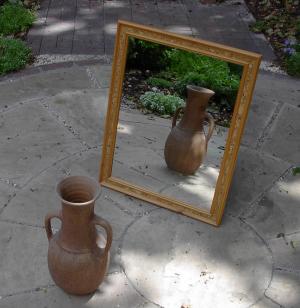
How often do you cringe when you look in the mirror? Worse yet, how many of you avoid the mirror all together? All this, because when you see yourself, all that you see is the little imperfections. You fail to look closer to see the beauty that is you — inside and outside.

You are the beauty that surrounds you. Everything and everyone is connected and you are as beautiful as that breathless sunset, the star-filled night or that perfect flower. True beauty is not at the superficial outer level — it is the whole package. How many of you know someone who is beautiful outside, but  who lacks those qualities of inner beauty, for example, empathy, lovingkindness and compassion? The truth is that even though we may agree that they are beautiful, they are no more perfect than the rest of us. Even more, their outer beauty is diminished by the ugliness of their inner being. Yet, our society kneels at the altar of outer beauty. It is a fact that beautiful people make more money for the same job than one who is less attractive and they garner more favors. All of this and they are no happier than the rest of us. Besides, beauty fades, but sincerity,  love, concern for others, compassion and kindness, like the finest wine, improves with age.

Let no one and nothing diminish the visage of your uniquely beautiful self. Go ahead, look into the mirror and consider the beauty of what you consider your imperfections. What love, wisdom, compassion and lovingkindness do they hold? How many hearts has your smile touched?  There is a reason that those lines which accentuate that smile are called ‘laugh lines.’ As you embrace them, and all that you see, you embrace the very best of yourself. So, look closely. See yourself with the love, kindness and compassion that you reserve for others. Oh, if you could see yourself as I see you, you’d know the meaning of true beauty.

postsiggie2